Nudges in Education
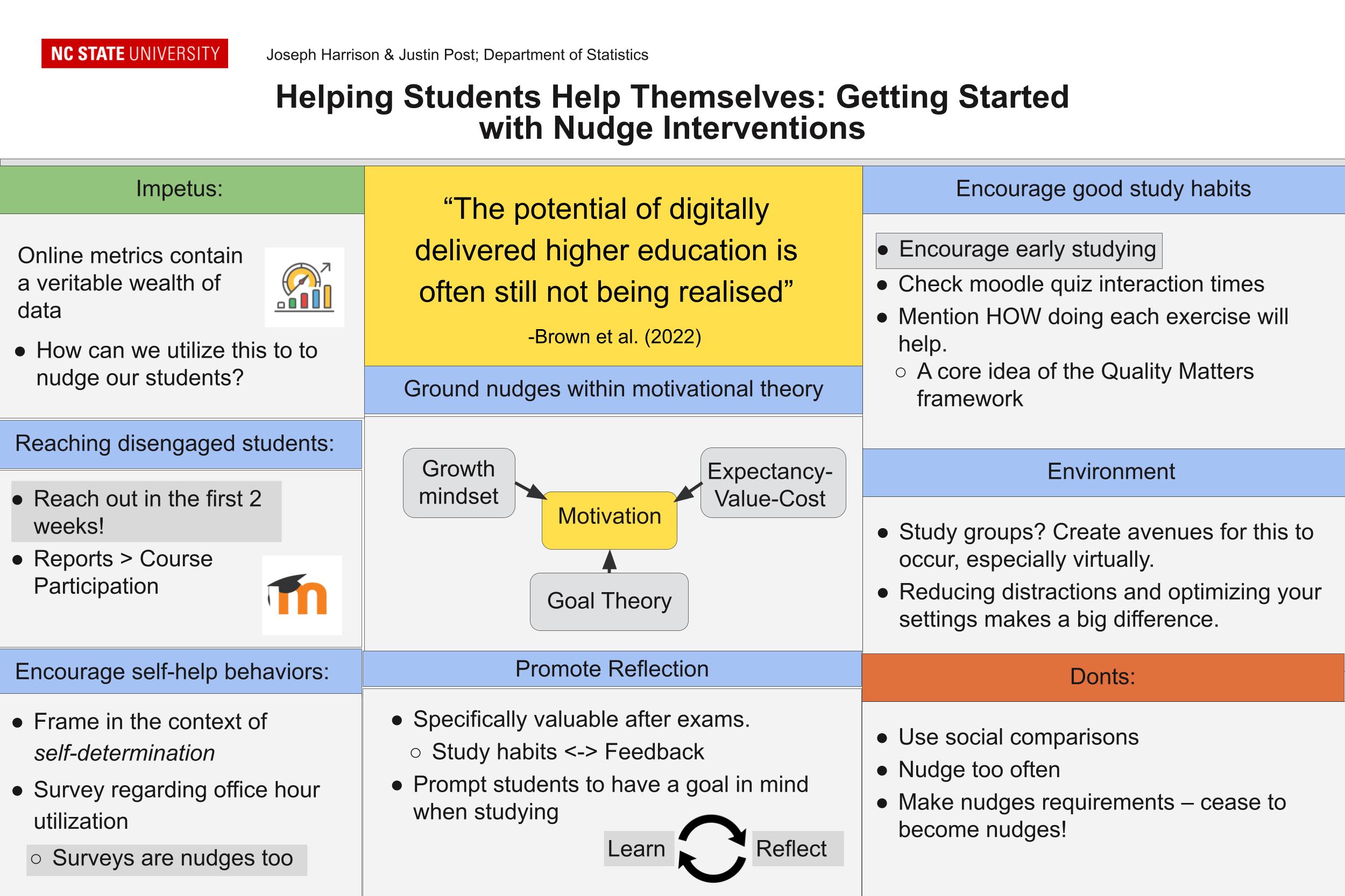
When discussing various nudges, we want to place these within a broader motivational framework of learning. Here are good review papers that outline the core tennets of primary approaches used to study motivation.
Note that it is quite possible for long-lasting changes to happen, and the student sees no (or negative) grade changes. Thus, having a clear understanding of what underpinning mechanisms you are targeting is valuable. End-points should not be the sole metric – there is room for qualitative data to help.
On the poster, there was not space to expound upon some of the points. Further details:
We focus here on digital courses. The quantity of backend analytics that any LMS provides is quite high, and can be utilized to the student’s benefit. Specifically, we here study how analytics-based nudges can be of help, where nudges are non-intrusive ways of prompting or guiding students without overly changing their incentives.
It is possible to easily identify those who are not engaging in the course by (on Moodle) going to Reports > Course Participation. The more that the course instructor checks and messages early on, the more that this process is normalized and sets the stage for future interactions.
- Have positive, supportive phrasing!
- People are not brains in a vacuum (as pointed out by the socio-emotional framework), and interpersonal connection matters.
Self determination is a broader motivational framework that goes particularly well with encouraging students to participate in office hours / take advantage of the resources available to them. Self-determination makes it’s focal element that of choice. Students choose how to participate in the course, rather than choices drifting by. Agency is valuable.
How often are students critically evaluating their study habits and developing study goals? By nudging, teachers can help support this calibration, hopefully guiding students towards acheiving self-regulated learning.
An example of a nudge to encourage good study habits is to open review materials 2 weeks in advance. We know that spaced learning is how students learn the best, and this small nudge promotes the option to learn more effectively. In a similar vein to the point made regarding self-help behaviors, surveys are nudges – ask about their study habits! Interacting with the material 1 hour before the deadline does not actually prepare them, thereby rendering the point of the assignment moot.
Lastly, regarding social comparison, to promote a “mastery orientation”, we want to minimize social comparison. If students are afraid of looking bad in front of others, they are focused on performance, rather than adopting mastery goals (ref).